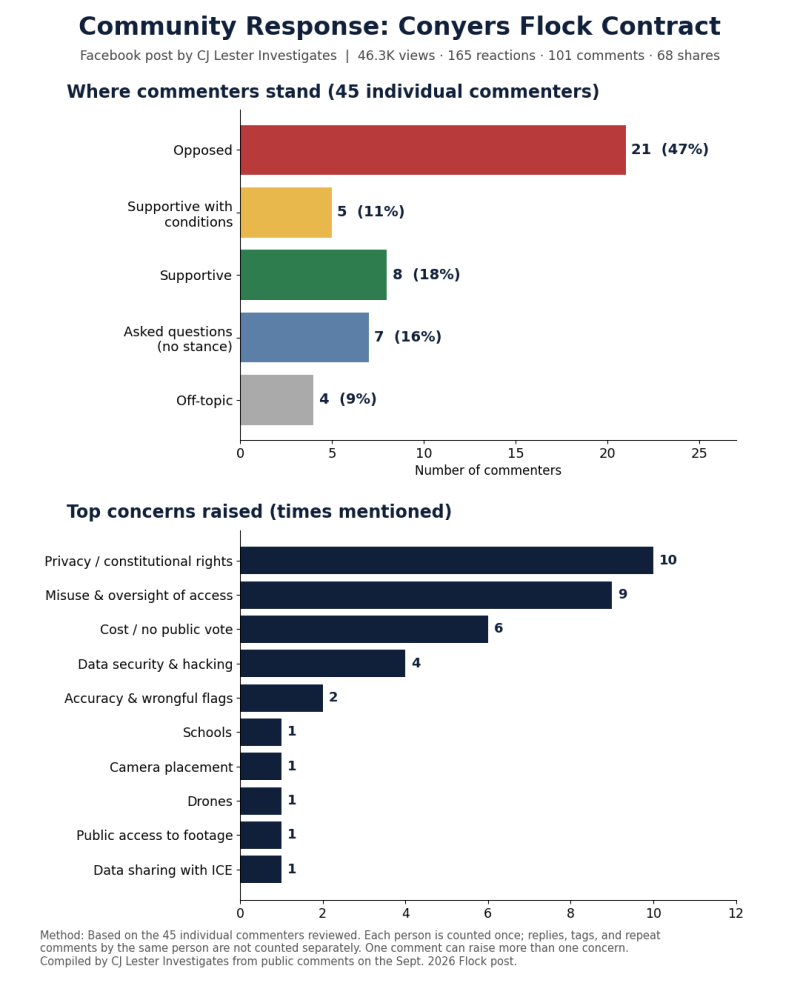
My first story on the Conyers Police Department's 10-year, $6.86 million contract with Flock Safety reached more than 46,000 people on Facebook and drew 101 comments. I went through what 45 individual commenters said and sorted their views and concerns.
Then I went back to the contract the City of Conyers released to me under the Georgia Open Records Act to see what it says about each concern. Here is what I found.
Where Commenters Stand
- Opposed: 21 people (47%)
- Supportive: 8 people (18%)
- Supportive with conditions: 5 people (11%)
- Asked questions without taking a side: 7 people (16%)
- Off-topic: 4 people (9%)
This is not a scientific poll. People who comment on Facebook are not a random sample of Conyers, and people with strong feelings are more likely to speak up. It shows what commenters said, not what the whole city thinks.
The five "supportive with conditions" commenters are worth noting. They said they could support the system if there were proactive protection against abuse, clear rules on who has access, and consequences for anyone who misuses it.
The Concerns, One by One
Privacy and constitutional rights (10 mentions)
The most common concern was privacy. Several commenters said the cameras track innocent people with no suspicion of a crime, and asked how that fits with the Fourth Amendment. Others pointed out that people are already recorded by store cameras and carry phones that track them everywhere.
What the contract says: The agreement limits use to a "Permitted Purpose," defined as legitimate public safety purposes, including preventing and prosecuting crime and investigations. The same definition also includes "prevention of commercial harm." The contract does not address constitutional questions. That is a question for the chief and, ultimately, the courts and lawmakers.
Misuse and oversight of access (9 mentions)
Commenters pointed to the July 2026 arrest of a Conyers Police Department dispatch supervisor, who was charged by the Georgia Bureau of Investigation with misusing the license plate reader system. Several asked who has access, how accounts are vetted, and how misuse is caught before it happens rather than after.
What the contract says: The city is responsible for "all acts and omissions" of the people it gives access to, and Flock can suspend access if the system is used for anything other than its permitted purpose. The contract does not describe how often access is audited or by whom. That depends on the department's own policy, which I have asked the chief to share.
Cost and no public vote (6 mentions)
Commenters asked why residents paying for the system had no say. Some estimates circulating online were far higher than the real cost.
What the contract says: The total is $6,857,386 over 10 years, starting at $296,403 in Year 1 and rising to $891,000 in Year 10. Chief R. Scott Freeman signed it on September 30, 2025. The records I have received so far do not show a City Council vote; I have requested council minutes and the city's purchasing policy to confirm.
The contract does give council a way out. If council does not fund Flock in a future budget, the city can end the agreement without penalty and does not have to repay any discounts.
Data security and hacking (4 mentions)
Commenters asked where the data is stored, how long it is kept, and what protects it from hackers.
What the contract says: Flock deletes footage on a rolling 30-day basis unless the order form says otherwise, and this order form sets a 30-day retention period. The data belongs to the city, and Flock says it "does not own and shall not sell" customer data. Flock is required to carry $5 million in cyber liability insurance.
There are exceptions worth knowing. Flock may use data stripped of identifying details to train its machine learning systems. Flock may also disclose footage to law enforcement, government officials, or third parties if legally required or if it believes in good faith that disclosure is necessary. And if the city chooses to share data with an outside party, that party may keep it longer than 30 days.
Accuracy and wrongful flags (2 mentions)
Commenters asked what happens to someone wrongly flagged or accused because of the system.
What the contract says: Flock does not guarantee the system will be "uninterrupted or error free," and it limits its own liability for inaccurate data. In other words, the contract puts responsibility for how results are used on the city.
Other questions
- Schools: The plan calls for connecting video from up to four schools, with Rockdale County Public Schools listed as the top priority. The school agreement was still pending when the contract was signed. It does not say whether cameras would be inside or outside buildings.
- Drones: The contract includes three drones for a "Drone as First Responder" program, which sends a drone to certain emergency calls.
- Camera placement: The contract says Flock advises on locations and can veto spots where cameras won't work well. It does not say how the city chooses locations.
- Footage for residents: The contract does not address whether residents can get footage after a crash or crime.
- Immigration enforcement: The contract does not mention federal immigration authorities.
What the Contract Doesn't Answer
Many of the most important questions, including audits, camera placement, footage access, and data sharing with outside agencies, are not answered by the contract at all. They depend on the department's own policies and decisions.
That is why the interview matters. I have a meeting scheduled with Chief Freeman on October 12, including an interview and a walkthrough of the department's Flock operations. I have sent him residents' questions, and I will report back with articles and video.
If you have a question you want answered, contact me at cj@cjlesterinvestigates.com.
Add comment
Comments