When Conyers residents commented on the city's Flock Safety cameras, the concern raised most often was privacy and the Constitution. Here is a plain-language look at what courts have decided and what is still unsettled.
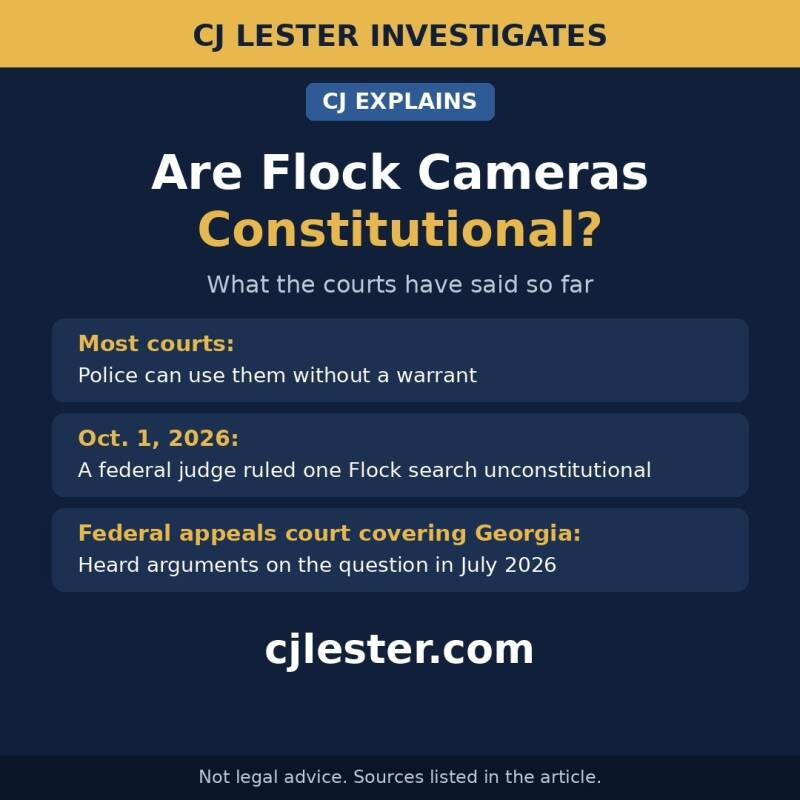
The short answer: so far, appeals courts have upheld the use of Flock cameras without a warrant. But a federal judge ruled against a Flock search on October 1, a Norfolk state trial judge has also ruled the other way, and the federal appeals court that covers Georgia heard arguments on the question in July.
What the Fourth Amendment Protects
The Fourth Amendment bars "unreasonable searches and seizures." When police conduct a "search," they generally need a warrant. Courts decide whether something is a search mostly by asking whether people have a "reasonable expectation of privacy."
Four U.S. Supreme Court cases shape the Flock debate:
- United States v. Knotts (1983): A person traveling on public roads has no reasonable expectation of privacy in their movements from one place to another. Supporters of license plate readers rely heavily on this case.
- United States v. Jones (2012): Attaching a GPS device to a car and monitoring it for 28 days was a search. Several justices also raised concerns about long-term location tracking.
- Carpenter v. United States (2018): Police need a warrant to get historical cellphone location records, because those records can reveal "the whole of" a person's movements. Critics argue a large camera network can do the same thing.
- Chatrie v. United States (2026): On June 29, the Court ruled 6-3 that using a geofence warrant to obtain cellphone location data is a search under the Fourth Amendment. The case did not involve license plate cameras, but some legal observers say its reasoning could reach beyond phones.
Flock in the Courts
In Norfolk, Virginia, two Hampton Roads residents represented by the Institute for Justice sued the city in 2024 over its network of 176 Flock cameras. They argued that recording every driver's travels without a warrant is unconstitutional.
In January 2026, a federal judge ruled for Norfolk. He found the residents could not show the city's camera network was capable of tracking "the whole of a person's movements," so using it was not a search. But he also wrote that the Fourth Amendment analysis "must remain nimble" as technology advances.
The residents have appealed to the U.S. Court of Appeals for the Fourth Circuit. That court does not cover Georgia, so its ruling would not be binding here, though it would be influential.
Norfolk's state courts have also split on the question. In 2024, a Norfolk Circuit Court judge ruled that police needed a warrant to search Flock data and threw out the evidence. In a separate case, the Court of Appeals of Virginia later reversed a similar ruling, finding no warrant was needed because the cameras photographed a car on public roads.
Recent Federal Rulings
Since the Supreme Court's Chatrie decision, federal judges have begun applying it to Flock cameras, and they have reached different results.
In September 2026, a federal court in California found that the use of Flock cameras in the case before it was not a Fourth Amendment search.
On October 1, 2026, U.S. District Judge Sara Hill in Oklahoma ruled the opposite way in a different case. She found that a deputy's Flock search, run without a warrant, was an unconstitutional search, and described the license plate reader network as a form of "indiscriminate mass surveillance." That ruling can be appealed to the Tenth Circuit, which does not cover Georgia.
The Case That Matters Most for Georgia
The U.S. Court of Appeals for the Eleventh Circuit covers Georgia, Florida, and Alabama. It heard oral argument on July 29, 2026, in a case about how the Fourth Amendment applies to license plate reader systems like Flock's. Unlike the Norfolk and Oklahoma cases, its decision would be binding on federal courts in Georgia.
What Georgia Law Says
Georgia has its own license plate reader law, O.C.G.A. § 35-1-22. It allows police to use the data only for law enforcement purposes, makes misuse a "misdemeanor of a high and aggravated nature," and requires agencies that use the system to maintain policies for its use and operation. The plate data itself is not available through Georgia's Open Records Act.
In July 2026, the Georgia Bureau of Investigation charged a Conyers Police Department supervisor with misusing the license plate reader system. As of late August, at least 14 people had been arrested and charged in Georgia this year for misusing the cameras, according to the GBI. The Georgia Sheriffs' Association and the Georgia Association of Chiefs of Police have formed a task force, joined by state Sen. John Albers, to examine whether new rules are needed.
What This Means for Conyers
Appeals courts have generally allowed warrantless use of Flock cameras, but recent rulings show the question is still open. Conyers' 10-year contract goes beyond license plate readers, adding live video, drones, and a platform that combines police, court, and code enforcement data. Courts have not yet decided whether a larger, combined system changes the constitutional picture.
Conyers Police Chief R. Scott Freeman discussed the department's view of the Fourth Amendment in an October 12 interview with CJ Lester Investigates. That story publishes Saturday, October 17.
Sources
U.S. Supreme Court cases
- United States v. Knotts, 460 U.S. 276 (1983)
- United States v. Jones, 565 U.S. 400 (2012)
- Carpenter v. United States, 585 U.S. 296 (2018)
- Chatrie v. United States (decided June 29, 2026). Summary: Congressional Research Service, "Geofence Warrants and the Fourth Amendment: The Supreme Court Weighs In," https://www.congress.gov/crs-product/LSB11274
Norfolk, Virginia, cases
- Schmidt v. City of Norfolk, No. 2:24-cv-621 (E.D. Va., Jan. 27, 2026), 819 F. Supp. 3d 492
- Schmidt v. City of Norfolk, Fourth Circuit Court of Appeals, No. 26-1227 (pending), docket: https://dockets.justia.com/docket/circuit-courts/ca4/26-1227
- Judge Mark S. Davis quote: Virginia Business, "Law 2026: The Hon. Mark Steven Davis," Aug. 30, 2026, https://virginiabusiness.com/law-2026-the-hon-mark-steven-davis/
- Commonwealth v. Bell, Norfolk Circuit Court (May 10, 2024), as reported by Virginia Lawyers Weekly, https://valawyersweekly.com/2024/06/10/criminal-photos-obtained-through-plate-reader-suppressed/
- Commonwealth v. Church, Court of Appeals of Virginia, Record No. 0737-25-1, https://www.vacourts.gov/static/opinions/opncavwp/0737251.pdf
Recent federal rulings and pending appeals
- U.S. District Judge Sara Hill ruling (Oklahoma, Oct. 1, 2026), as reported by 404 Media, https://404media.co/federal-judge-rules-a-flock-search-was-indiscriminate-mass-surveillance-and-unconstitutional
- Orin Kerr, "Use of Flock Cameras Is Not a Fourth Amendment 'Search,' District Court Rules," Stanford Law School (originally in The Volokh Conspiracy, Sept. 16, 2026), on the California ruling and the Eleventh Circuit's July 29 argument, https://law.stanford.edu/?p=588251
Georgia
- O.C.G.A. § 35-1-22 (Georgia's license plate reader law)
- Georgia Recorder, "GOP lawmakers call for more oversight of license plate cameras after string of misuses in Georgia," Aug. 25, 2026, https://georgiarecorder.com/?p=46750
Conyers
- Flock Group, Inc. Amendment Order Form, Safe City Program Addendum, and Statements of Work, City of Conyers Open Records Response CH-277-2026
- WSB-TV, report on the July 2026 GBI charge against a Conyers Police Department employee for misuse of Flock data, https://www.wsbtv.com/news/local/rockdale-county/crime-center-operator-accused-misusing-flock-data-track-domestic-partner-charged-by-gbi/DZ25LBIL2VEB3CGJKZVSLGOMBA/
CJ Lester is not a lawyer. This explainer summarizes court rulings and state law for general information, not legal advice.
If you have a question about how Conyers government works, contact me at cj@cjlesterinvestigates.com.
Add comment
Comments