By CJ Lester | CJ Lester Investigates | October 18, 2026
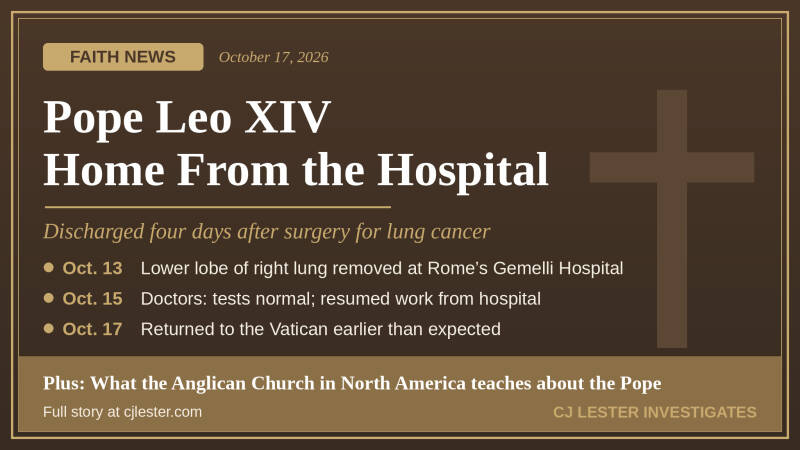
Pope Leo XIV left Rome's Gemelli Hospital on Saturday, Oct. 17, four days after surgeons removed part of his right lung and the Vatican confirmed he has lung cancer.
The 71-year-old pope walked out of the hospital at about 3:30 p.m. Rome time, according to OSV News. The Vatican said he will lead the Angelus prayer on Sunday from the window of the papal apartment.
A Routine Exam, Then Surgery
Leo announced on Sunday, Oct. 11, after the Angelus prayer, that doctors had found a "nodule in the lung" at a very early stage during a routine exam. He said he would follow his doctors' advice to have it removed.
He was admitted to Gemelli on Tuesday, Oct. 13, and had surgery that day. Doctors removed the lower lobe of his right lung. He was in the operating room for about three hours, and the surgery itself lasted about 90 minutes, according to ABC News.
Doctors diagnosed lung adenocarcinoma, the most common type of non-small cell lung cancer. Vatican News reported that more tests on the removed tissue were planned in the days after surgery.
Back to Work From the Hospital
On Thursday, Oct. 15, his physician, Dr. Luigi Carbone, and Gemelli's head of thoracic surgery, Dr. Stefano Margaritora, said his post-surgery tests were normal and a chest X-ray showed his lung was recovering well, according to the Associated Press. That day, Leo resumed work from the hospital and met with Archbishop Paolo Rudelli, the Vatican's chief of staff. He also celebrated Mass in a chapel set up near his room on the hospital's 10th floor.
Fox News reported that while recovering, Leo called Russian President Vladimir Putin and urged a ceasefire in the Ukrainian city of Oleshky.
On Friday, the Vatican released the first photos of Leo since the surgery, showing him celebrating Mass in the hospital chapel.
On Saturday morning, the Holy See Press Office announced that blood tests and a chest X-ray confirmed he was well enough to go home. The Vatican had originally said he would stay about a week. Before leaving, he visited the hospital's children's cancer ward, where children had written him letters, according to Fox News.
Vatican spokesman Matteo Bruni did not announce any changes to Leo's planned trip to South America, including Peru, scheduled for Nov. 6–17.
Leo, who was born in Chicago, was elected pope in May 2025 after the death of Pope Francis. Francis was treated at Gemelli shortly before he died in April 2025 at age 88.
Church of England Leader Offers Prayers
Archbishop of Canterbury Sarah Mullally, who leads the Church of England, said after the diagnosis that the pope was in her daily prayers, according to ITV News. Mullally, the first woman to hold the office, met Leo at the Vatican on April 27, 2026.
The Anglican Church in North America (ACNA) does not look to the Archbishop of Canterbury for leadership. The ACNA was formed in 2009 by traditional Anglicans who left the Episcopal Church and the Anglican Church of Canada. It is a member of the Global Fellowship of Confessing Anglicans (GAFCON), a network of conservative Anglican churches, many of them in Africa.
In October 2025, after Mullally was named, GAFCON leaders announced they were cutting ties with Canterbury. GAFCON said in 2023 that it no longer recognized the Archbishop of Canterbury as a focus of unity or "first among equals" among Anglican leaders. GAFCON chairman Archbishop Laurent Mbanda of Rwanda cited Mullally's support for blessing same-sex relationships.
What the ACNA Teaches About the Pope
The ACNA's official beliefs are set out in its Fundamental Declarations, part of its constitution. The ACNA receives the Thirty-Nine Articles of Religion of 1571 "in their literal and grammatical sense" as expressing fundamental Anglican beliefs. It also receives the 1662 Book of Common Prayer as a standard for doctrine. The Jerusalem Declaration of 2008, adopted by GAFCON and printed in the ACNA's 2019 Book of Common Prayer, says the Articles contain the true doctrine of the Church and remain authoritative for Anglicans today.
Where ACNA Anglicans and Roman Catholics Agree
The ACNA describes itself as part of the "One, Holy, Catholic, and Apostolic Church," the same phrase from the Nicene Creed that Roman Catholics use. Both churches:
- Confess the Apostles' and Nicene Creeds, including the Trinity and the death and resurrection of Jesus Christ. The ACNA also receives the Athanasian Creed.
- Affirm the teaching of the early church councils. The ACNA affirms the first four councils and accepts the later three as far as they agree with them.
- Keep the ancient order of bishops, priests, and deacons in historic succession.
- Celebrate Baptism and Holy Communion, worship with formal liturgy, and follow the church calendar.
Where They Differ
The main difference is authority. Roman Catholics believe the pope, as successor to the Apostle Peter, leads the whole Church on earth and holds authority over all bishops. The ACNA does not accept that teaching.
ACNA Anglicans regard the pope as the Bishop of Rome, a bishop of one historic church. They teach that Jesus Christ alone is head of the Church, citing Ephesians 1:22 and Colossians 1:18. They also point to 1 Peter 5:1, where Peter calls himself a "fellow elder" with other church leaders.
Catholics read Matthew 16:18, where Jesus tells Peter that he will build his church "on this rock," as establishing Peter and his successors in Rome as leaders of the Church. Many Anglicans, following the Reformers and some early church writers, read the "rock" as Peter's confession that Jesus is the Christ.
Because the ACNA receives the 1571 text of the Articles, the following statements are part of its official teaching:
- Article 37 states that the Bishop of Rome has no jurisdiction in England.
- Article 6 teaches that Scripture contains everything necessary for salvation, and nothing that cannot be proven from Scripture may be required as a matter of faith.
- Article 19 states that the Church of Rome has erred.
- Article 21 states that even general councils of the Church can make mistakes.
- Article 22 rejects the Roman Catholic teaching on purgatory.
- Article 28 rejects transubstantiation.
- Article 32 permits clergy to marry.
For these reasons, the ACNA does not accept papal infallibility, which the First Vatican Council declared in 1870. It also does not require belief in doctrines defined by popes, such as the Immaculate Conception (1854) and the Assumption of Mary (1950).
In 1896, Pope Leo XIII declared Anglican ordinations invalid. That ruling remains Catholic teaching.
The formal dialogue between Rome and Canterbury, known as the Anglican–Roman Catholic International Commission (ARCIC), has been carried out through the Anglican Communion led from Canterbury. The ACNA is not a party to that dialogue.
Sources
- Vatican News, "Pope Leo XIV returns to Vatican after being discharged from hospital," Oct. 17, 2026
- Vatican News, "Pope Leo XIV to be discharged from hospital," Oct. 17, 2026
- OSV News via The Catholic Sun, "Pope Leo XIV discharged from hospital early following lung cancer surgery," Oct. 17, 2026
- ABC News, "Pope Leo XIV to be discharged from hospital and return to Vatican," Oct. 17, 2026
- Chicago Sun-Times, "Pope Leo leaves Rome's Gemelli hospital 4 days after lung cancer surgery," Oct. 17, 2026
- Associated Press, Oct. 15, 2026 health update (via ITV and Anchorage Daily News)
- Fox News, "Pope Leo XIV discharged from hospital, will return to Vatican after surgery to remove lung cancer," Oct. 17, 2026
- AAP (via Newcastle Herald), Oct. 13, 2026
- ITV News, "Pope Leo XIV diagnosed with lung cancer after 'successful' surgery," Oct. 13, 2026
- National Catholic Register / CNA, "Pope Leo XIV Meets Archbishop of Canterbury Amid Deepening Church Divides," April 2026
- Anglican Church in North America, Fundamental Declarations of the Province (Constitution, Article I)
- GAFCON, The Jerusalem Declaration (2008), as printed in the ACNA 2019 Book of Common Prayer
- Religion News Service, "Global Anglican ties are under stress," Nov. 19, 2025
- MinistryWatch, "Rejecting Canterbury Decision, Conservative Bishops Claim Lead of Anglican Communion," Oct. 2025
- Encyclopaedia Britannica, "Anglican Church in North America"
- The Thirty-Nine Articles of Religion (1571), Articles 6, 19, 21, 22, 28, 32, 37
- The Holy Bible: Matthew 16:18; Ephesians 1:22; Colossians 1:18; 1 Peter 5:1
- First Vatican Council (1870); Apostolicae Curae (1896)
Add comment
Comments