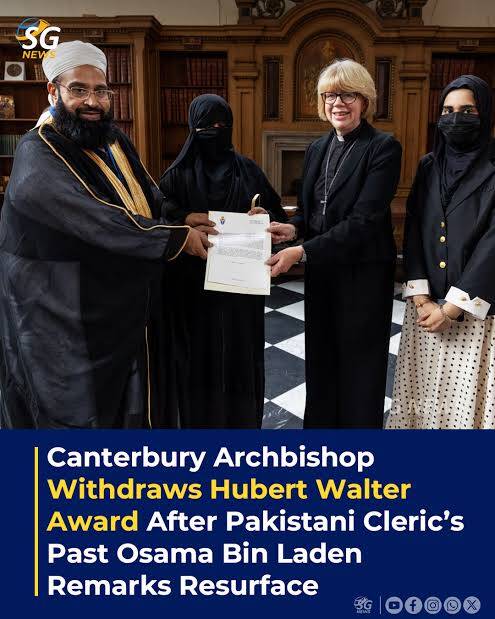
On September 11, 2026, the 25th anniversary of the 9/11 attacks, Archbishop of Canterbury Sarah Mullally stood at Lambeth Palace and presented an award for reconciliation and interfaith cooperation. Six days later, Lambeth Palace took it back.
I want to walk through what happened, because I think there's a lesson in it for every Anglican, and really for every Christian, no matter what church you call home.
What happened
The Lambeth Awards are honors the Archbishop of Canterbury gives each year to people who have made exceptional contributions to the Church of England, the wider Anglican Communion, or society. This year, 27 people received one.
One of them was Hafiz Muhammad Tahir Mehmood Ashrafi, chairman of the Pakistan Ulema Council. He received the Hubert Walter Award for Reconciliation and Interfaith Cooperation, named after a 12th-century Archbishop of Canterbury.
Lambeth Palace said the honor recognized Ashrafi's longtime support for religious minorities in Pakistan, especially Christians. It noted that many Christians there, including Pakistan's own Anglican Church, value that support. That matters. Christians in Pakistan face real danger, and anyone who stands with them deserves a fair hearing.
But within days, remarks Ashrafi made in 2007 resurfaced. At that time he said he would give Osama bin Laden the title "Saifullah," which can be translated "sword of God."
On September 17, Lambeth Palace announced the award had been withdrawn. Its statement said previous comments had "come to light" and led the palace to reconsider. It also said church officials continue to pray for Christians in Pakistan and for everyone working for interfaith harmony.
Ashrafi responded in a video, saying his words had been taken out of context and that he opposes using religion for terrorism.
The fallout hasn't stopped. A petition calling for Archbishop Mullally to resign has gathered thousands of signatures. Critics, including Anglican writers, have said the episode exposes a lack of basic due diligence at the top of the Church of England.
Why this matters to Anglicans here at home
Some of you might be asking why a church in Covington, Georgia, should care about an award handed out in London.
Here's why. The Archbishop of Canterbury has long been seen as the symbolic head of the worldwide Anglican Communion. Many Anglicans around the world, especially in the Global South, have already said they no longer recognize Canterbury in that role because of disagreements over doctrine. Moments like this one add to the questions people are asking about leadership, accountability, and trust.
When the most visible office in Anglicanism makes a mistake like this, it touches all of us who carry the Anglican name.
The real lesson: test before you honor
I don't believe this was about bad intentions. Honoring someone for protecting persecuted Christians is a good impulse. The failure was in the checking.
Paul told Timothy, "Do not be hasty in the laying on of hands" (1 Timothy 5:22). In context, he was talking about ordaining leaders. But the principle reaches further. When the Church puts its name and blessing on someone, it is vouching for them. That's not something to rush.
Proverbs puts it another way: "The one who states his case first seems right, until the other comes and examines him" (Proverbs 18:17). A good résumé is the first case. Examination is the second. Lambeth Palace heard the first and skipped the second.
And 1 John 4:1 is the verse at the heart of this whole page: "Test the spirits to see whether they are from God." That is what my SPIRIT Test is all about. We're not called to be suspicious of everyone. We're called to test, carefully and fairly, before we endorse.
Notice, too, what testing would have done. It wouldn't have required anyone to ignore Ashrafi's work for Pakistani Christians. It would simply have put all of the record on the table, the good and the troubling, before the Church attached its name to him. That's fairness, not hostility.
What this means for us
This isn't only a lesson for archbishops. It's for every one of us.
Before you share that sermon clip, recommend that teacher, or put a speaker in front of your church, look at the whole record. Don't stop at the highlight reel. Ask what they've said over time, not just what they're saying today.
It's also a reminder to pray for our leaders, including the ones we disagree with. Archbishop Mullally carries a heavy role, and the Church of England has walked through a hard few years. Holding leaders accountable and praying for them aren't opposites. Scripture asks us to do both.
The Church doesn't lose credibility by saying "we got this wrong." It loses credibility when it doesn't test in the first place.
"Test everything; hold fast what is good" (1 Thessalonians 5:21).
Let's seek the truth together.
— CJ Lester
Sources
- Christian Post, "Church of England revokes award to Muslim cleric who praised Osama bin Laden" (Sept. 2026)
- Christian Post, "Thousands back petition urging Archbishop of Canterbury Sarah Mullally to resign" (Sept. 2026)
- The Express Tribune (Pakistan), "Archbishop of Canterbury 'withdraws' award given to Tahir Ashrafi" (Sept. 2026)
- Lambeth Palace statement, September 17, 2026
Scripture quotations from the ESV.
Add comment
Comments