By CJ Lester | CJ Lester Investigates
Update: This story has been updated with responses from City Manager Kameron Kelley, an October 12 interview with Police Chief R. Scott Freeman, and written answers from Freeman on October 13.
I have 171 pages of records for you to look at, and they're all free. Download them at the bottom of this story.
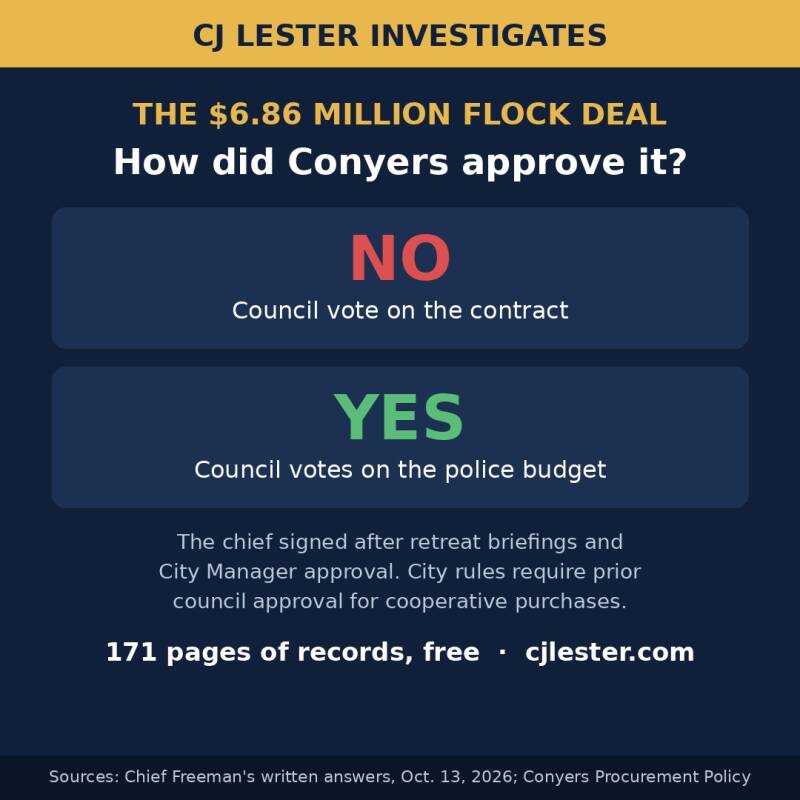
Conyers Police Chief R. Scott Freeman has confirmed in writing that the city's 10-year, $6.86 million agreement with Flock Safety did not go to the City Council for a formal vote. He says the council did vote on the police department budgets that paid for it.
The city says the agreement was bought through a state cooperative contract. The city's own purchasing policy says that kind of purchase requires prior approval from the City Council.
Freeman signed the agreement on September 30, 2025. Through the Georgia Open Records Act, interviews, and written questions, I have been asking how a deal that size was approved. Here is what the records and the city's and chief's answers show.
What the City Says
In response to my latest records request, the city wrote that the Flock agreement "was not utilized through sole source. Instead, the contract was entered into as a cooperative purchasing contract through the state" (Records Response CH-290-2026). The records are below for you to look at.
In a cooperative purchase, a local government buys through an agreement another government has already set up, instead of running its own bidding process. Georgia allows local governments to buy through many state contracts. Conyers' own policy sets an additional requirement for doing so.
What the City's Rules Require
The City of Conyers Procurement Policy, in effect since March 18, 2020, lists the duties of the Chief Financial Officer. One is joining cooperative purchasing plans with other governments, but only "with prior approval from the Conyers' City Council" (page 6).
The policy sets two other requirements that apply here:
- Multi-year contracts: Before using a contract that runs for more than one term, the city must determine in writing that its cost projections or escalation terms are "reasonably firm" and that it will serve the city's best interest (page 29).
- Cost analysis: Any contract not awarded through competitive sealed bidding requires a written cost or price analysis in the file (page 37).
For comparison, competitively bid contracts and those awarded through requests for proposals also need City Council approval (pages 16 and 18). Sole source purchases, which the city says this was not, require a written determination and sign-off by the Chief Financial Officer or City Manager (page 36).
What Records Exist, and What Don't
I asked for six specific records, including the name or number of any cooperative contract used and any council approval to participate in it.
The city answered the first five items together: because the agreement was not a sole source purchase, "no records exist responsive to this request."
That answer covered more than sole source paperwork. It also covered the multi-year determination, the cost or price analysis, the cooperative contract, and the council approval. I am asking the city to confirm whether the cooperative purchasing item was searched separately, and I have filed a new request for the state contract name and number and any council approval.
I will update this story when the city responds.
What Has Been Paid
The city did provide its payment records. The records are below for you to look at.
Flock billed $296,403 for the first year on October 8, 2025, describing the charge as "Year 1 of 120 Month Term." After a prorated credit of $63,668.09 for the city's earlier Flock agreements, the balance was $232,734.91.
The city paid by electronic transfer on October 14, 2025, six days after the invoice date and more than three weeks before it was due. The invoice's purchase order line is blank.
A handwritten account number on the invoice shows where the payment was charged: 20-50-930-54-000-5210. That account differs from the "Police Technology" line in the city's General Fund budget, which carries the prefix 10-10-030 and was budgeted at $492,401 for FY2026. I have asked the city what the account represents. The word "DRONE" is also handwritten beneath the invoice's single line item, "Flock Safety - Safe City."
The records also include a $500 pole replacement invoice from January 2026. No invoice for the second year, $447,758, was included.
What Council Did Vote On
The City Council votes on the budget each year. On June 17, 2026, it adopted the FY2027 budget through Ordinance 1475, setting spending totals by department, including $11,891,284 for Police, $2,741,515 for Technology, and $101,052 for the Real-Time Crime Center. Section 4 grants authority "to the City Manager and/or their designee" to approve spending within those totals.
That is a vote on department budgets, not on the Flock agreement itself.
Other city agreements show a different signing process. The School Resource Officer agreement with the Rockdale County School District, which the city produced when I asked for any Flock school camera agreement, was signed by the Mayor, attested by the City Clerk, and approved as to form by the City Attorney. The Flock agreement bears only Chief Freeman's signature for the city.
The City's Response
After this story was first published, City Manager Kameron Kelley responded to written questions.
Asked which procurement path the agreement followed, Kelley wrote: "The Flock agreement is considered cooperative purchasing."
Asked whether the Mayor and City Council voted on the agreement, he wrote that they "were informed of this agreement and the intent to consolidate the existing agreements, which helped streamline annual budget planning."
Asked what authority allowed the Chief of Police to sign it, he wrote that the chief "has signed the Flock agreements for the City after speaking with the Mayor, Council, and City Manager due to the agreements being within the operational expertise of the Police Department."
Asked which budget line pays for Flock, he wrote: "Flock is funded using the Public safety portion of SPLOST."
He did not identify the cooperative contract used.
What Chief Freeman Said
In an in-person, on-the-record interview at the Conyers Police Department on October 12, Freeman explained how the agreement came together.
He said the council approves his department's spending through the annual budget. "Nothing is ever purchased without going through some approval process," he said.
He said the Safe City agreement combined separate contracts for license plate readers, drones, gunshot detection, and Flock's 911 software into one. "I signed all of those," he said of the earlier agreements. Records show Freeman signed the original 2020 agreement as deputy chief and the 2025 agreement as chief. A 2021 expansion was handled through a city purchase order, and a 2022 expansion was approved by City Council vote.
Combining the contracts into a 10-year term brought discounts totaling about $2.5 million, according to the agreement. "The more you sign, the more of a discount you can get," Freeman said.
He said the agreement was written so the Mayor and Council can end it for budget reasons, and that he briefs the council on the department's technology plans at its annual retreats. "I don't ever do anything in a vacuum," he said.
Freeman said a cooperative agreement and a state contract are "essentially one and the same" in his experience. He said Flock has a cooperative agreement but that he could not remember which organization it is through, and that the City Manager had that information.
The Chief's Written Answers
After the interview, Freeman sent written answers and documents on October 13. The records are below for you to look at.
Asked whether the Safe City agreement went to the City Council for a formal vote, Freeman wrote: "No."
He wrote that the agreement "combined a series of Flock contracts and agreements that I executed on behalf of the Conyers Police Department from 2020 through 2025," replaced them with one agreement, and applied credits and discounts based on its 10-year length.
Freeman wrote that, beginning in 2019, he presented public safety technology plans to the Mayor and City Council at their annual retreats. "As Deputy Chief of Police, and now as Chief of Police, I have signed all related agreements after those technology presentations, consultation with the Chief Financial Officer, and approval by former City Manager Tony Lucas and current City Manager Kameron Kelley," he wrote.
He added that Flock costs were included in the police department's annual budget requests. "Each year, the Mayor and City Council voted to approve the Police Department budget, which included funding for all requested police technology," he wrote.
Freeman also provided the department's cost estimate for the six officer positions, which he described as "frozen (not cut)." Using an annual cost of $77,328.20 per officer, including pay and benefits, with a 4.5% yearly increase, the department estimates the 10-year cost of six officers at $5,701,350.67. That is about $1.16 million less than the $6,857,386 Flock agreement. Kelley, meanwhile, said Flock is funded through the public safety portion of SPLOST. I am asking the city how the frozen positions and SPLOST funding fit together, and how the difference is covered.
Inside the Interview
The October 12 visit to the Conyers Police Department was scheduled as a three-hour program. It included a national briefing video from the International Association of Chiefs of Police, a presentation on the department's monthly Flock audit process, four case reviews, a demonstration of the upgraded Real-Time Crime Center, and a one-on-one interview with Freeman. Deputy Chief Kim Lucas and Captain Garcia also took part.
Misuse and Accountability
In July 2026, the Georgia Bureau of Investigation charged a supervisor in the department's Real-Time Crime Center with misusing license plate data. The searches were flagged during an audit, according to the department.
The department's license plate reader policy, SOP 5-30, effective July 8, 2024, requires every search to be documented with a "search reason" and requires monthly audits by the Administrative Lieutenant, with violations reported to a captain. The policy says officers must confirm a plate and check it through state and national crime databases before making a stop, and that "ALPR alerts/hits alone do not constitute reasonable suspicion or probable cause for a stop." The policy also states that "reasonable suspicion or probable cause is not required before using the ALPR system." The records are below for you to look at.
The policy covers license plate readers. It does not address the live video cameras, drones, or other tools added in the September 2025 agreement.
Freeman said misuse is a statewide problem and that almost 50 officers in Georgia have been arrested, fired, disciplined, or suspended for misusing the technology. A database kept by the Institute for Justice, a public interest law firm that tracks license plate reader abuse, counted 57 of 170 incidents nationwide in Georgia as of late August. Those incidents include officer misuse as well as wrongful stops. "Can we do a better job? Absolutely. Will we do a better job? Absolutely," he said.
Freeman provided a September 2026 set of joint principles for license plate reader use, signed by 12 national law enforcement organizations, including the International Association of Chiefs of Police and the National Sheriffs' Association. The principles call for written policies, documented queries, routine audits, and disciplinary consequences for misuse. Freeman wrote that he supports the principles and believes the department's policy "already aligns with these guidelines." He wrote that the policy is due for its annual review and that the department will amend it after the 2027 legislative session ends.
Privacy and the Fourth Amendment
"I disagree with people and their perceptions that it is an invasion of privacy," Freeman said. "I respect their right to have that belief."
He said courts have repeatedly found that photographing a license plate on a public road is not a Fourth Amendment search. "Right now, there is not one single court in the land that I am currently, as we sit here, am aware of, that has said that using LPR technology, as this department has it deployed, is a violation of the Fourth Amendment," he said. "Now, if that changes, then my answer will change."
Most courts that have considered the question have sided with police. On October 1, 2026, a federal judge in Oklahoma ruled that a deputy's warrantless Flock search in that case was unconstitutional.
What the Public Can See
Freeman pointed residents to the department's Flock transparency portal. As of October 12, 2026, it listed 141 total cameras, including 51 license plate readers; 522 searches and 56,346 hotlist hits in the previous 30 days; 30-day data retention; and prohibited uses including immigration enforcement, traffic enforcement, harassment, and personal use.
Freeman wrote that Flock data is hosted in the United States on encrypted Amazon Web Services servers and that Flock's products comply with the FBI's Criminal Justice Information Services requirements.
The department's drone program page listed 32 calls and an average response time of 101.5 seconds as of October 12. The department also publishes an annual report and offers a CPD mobile app.
"We're not keeping secrets," Freeman said. "We are literally open source, open book."
What's Next
I am asking the city to identify the cooperative contract used, to explain which SPLOST referendum covers the payments, and to explain how the frozen officer positions and SPLOST funding fit together. I am also requesting the police department's technology presentations from City Council retreats, 2019 through 2026. I will update this story when the city responds.
The documents referenced in this story are posted below so you can read them yourself.
If you have information about this agreement or any City of Conyers matter, contact me at cj@cjlesterinvestigates.com.
Sources
- Interview with Conyers Police Chief R. Scott Freeman, Conyers Police Department, Oct. 12, 2026 (audio and video recorded)
- Email from Chief R. Scott Freeman to CJ Lester Investigates, Oct. 13, 2026, with attached "CPD Data" document (Flock billing schedule and personnel cost projections), Conyers PD SOP 5-30 (Automated License Plate Recognition System, effective July 8, 2024), and Joint Law Enforcement ALPR Principles (September 2026)
- Conyers Police Department meeting agenda, "Conyers PD and Flock Safety," Oct. 12, 2026
- Conyers GA PD Flock Transparency Portal, https://transparency.flocksafety.com/conyers-ga-pd, viewed Oct. 12, 2026
- Conyers PD Drone as First Responder page, https://community.conyers.ga.us.aerodome.com, viewed Oct. 12, 2026
- Atlanta News First, "Conyers police supervisor arrested after Flock audit, department says," July 23, 2026, https://www.atlantanewsfirst.com/2026/07/23/conyers-police-supervisor-arrested-after-flock-audit-department-says/
- 404 Media, "Federal judge rules a Flock search was indiscriminate mass surveillance and unconstitutional," https://404media.co/federal-judge-rules-a-flock-search-was-indiscriminate-mass-surveillance-and-unconstitutional
- Email from City Manager Kameron Kelley to CJ Lester Investigates, October 2026
- City of Conyers Open Records Response CH-290-2026: city's written response; Flock Invoice INV-76257; bank transfer record dated Oct. 14, 2025; Flock Invoice INV-84301
- City of Conyers Open Records Response CH-283-2026: City of Conyers Procurement Policy (No. 10-02-07, effective March 18, 2020); FY2026 budget (Technology, page 167); Ordinance No. 1475 (FY2027 budget, adopted June 17, 2026); School Resource Officer Agreement with the Rockdale County School District
- City of Conyers Open Records Response CH-277-2026: Flock Group, Inc. Amendment Order Form and signature page (Sept. 30, 2025)
- City of Conyers Open Records Response CH-259-2026: earlier Flock agreements, 2020–2024, and March 16, 2022 City Council minutes
- The Center Square, "Database Shows Abuse of License Plate Readers; Police Defend Their Use," Aug. 26, 2026, https://dailysignal.com/2026/08/26/abuse-of-license-plate-readers
- Institute for Justice, "The IJ Database of ALPR Abuse," https://ij.org/the-ij-database-of-alpr-abuse/
Documents
- [Read all 171 pages of records referenced in this story
Add comment
Comments